Peptide Hair Care in South Africa: AHK-Cu Spray vs Serum
If you have been searching for peptide hair care in South Africa, most of what you will find is either a compound explainer or a broad copper-peptide skincare guide. This article is a format guide. It compares a leave-on AHK-Cu scalp spray with a leave-on AHK-Cu hair and scalp serum, explains where the matching rinse-off shampoo and conditioner sit, and sets out what published laboratory literature has examined. It is not a claim that any of these products grow hair, reverse greying or treat a scalp condition.
What is AHK-Cu?
AHK-Cu is a copper tripeptide: L-alanine, L-histidine and L-lysine bound to a copper(II) ion. On a cosmetic ingredient list (INCI) it appears as Copper Tripeptide-3. Its close relative GHK-Cu (glycyl-histidyl-lysine copper) appears as Copper Tripeptide-1. The two peptides differ by a single amino acid at the start of the chain.
Our cosmetic-grade AHK-Cu powder lists the material as copper tripeptide-3 (Ala-His-Lys·Cu2+). A PubChem record labelled AHK-Cu (CID 168431292) also lists CAS 682809-81-0 for a monohydrochloride form of the complex. We published a longer compound-level overview in our earlier article on AHK-Cu copper peptide for hair. The rest of this guide focuses on how the finished formats differ for laboratory cosmetic research.
What has AHK-Cu been studied for?
The published literature on AHK-Cu is still limited, and almost all of it is laboratory work rather than trials of a finished spray or serum on people. The paper most often cited is a 2007 study by Pyo and colleagues in Archives of Pharmacal Research. The authors applied L-alanyl-L-histidyl-L-lysine-Cu2+ (AHK-Cu) to isolated human hair follicles kept alive outside the body and to cultured dermal papilla cells, the specialised fibroblasts at the base of the follicle. In those laboratory models they reported follicle elongation and dermal papilla cell proliferation.
That is background on what the ingredient has been examined for. It is not evidence of a result from a topical cosmetic product, and it does not mean a spray or serum will produce hair growth or treat hair loss.
GHK-Cu, which appears alongside AHK-Cu in our rinse-off shampoo and conditioner, has a larger published record. A 2018 review by Pickart and Margolina in the International Journal of Molecular Sciences discusses laboratory work on GHK-Cu and gene expression, including pathways linked to the extracellular matrix such as collagen-related signalling. That, too, is research on the ingredient rather than a promise about a finished product.
AHK-Cu scalp spray vs hair and scalp serum
We stock two leave-on AHK-Cu formats in the cosmetics collection:
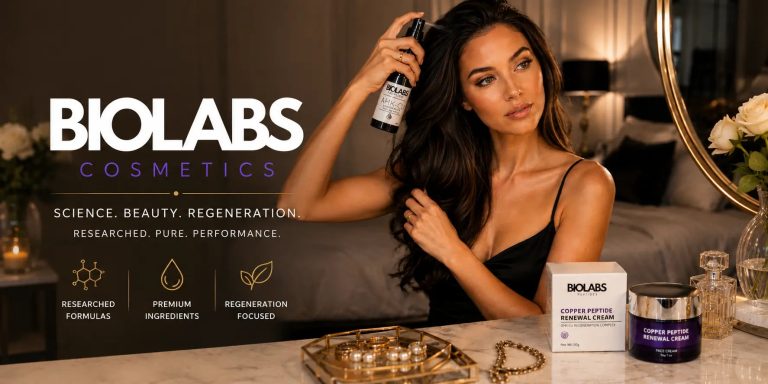
- The 1% AHK-Cu Hair & Scalp Spray, 60 ml, described on the product page as a leave-on cosmetic scalp spray.
- The 1% AHK-Cu Hair & Scalp Serum, 50 ml, described as a lightweight leave-on cosmetic scalp serum.
Both are formulated with 1% AHK-Cu copper peptide, rosemary hydrosol and hyaluronic acid. The full INCI list is printed on the pack rather than repeated on the product page, so anyone comparing batches should check the physical label.
How the formats differ
The two products share the same stated peptide percentage and the same supporting ingredients named on the product pages. The difference is the delivery format:
- Spray, 60 ml. A spray is a leave-on liquid delivered as a mist, typically chosen when an even film over a wider surface is useful.
- Serum, 50 ml. The serum is a lightweight leave-on liquid, typically chosen when more controlled, localised placement is useful.
- Pack size. The spray is supplied as 60 ml and the serum as 50 ml, so they are not interchangeable on volume alone.
- Same handling family. Both are finished leave-on cosmetics, not raw materials and not lyophilised research vials. They do not need reconstitution.
If a protocol needs the leave-on 1% AHK-Cu formula, the choice between these two is about application style and pack size rather than about chemistry.
Shared storage and label notices
The live spray and serum pages give the same storage notes: keep them in a cool, dry place away from direct sunlight, and close the container after use. Both also say the products are for external cosmetic use only, to avoid contact with eyes and broken skin, to patch test before use, and that no specific outcome is promised.
Where shampoo and conditioner fit
Two rinse-off products sit alongside the spray and serum in the same collection:
- The GHK-Cu + AHK-Cu Fortifying & Smoothing Shampoo, 400 g, lists both Copper Tripeptide-1 (GHK-Cu) and Copper Tripeptide-3 (AHK-Cu), together with sulfate cleansing agents, dimethicone, dimethiconol and guar hydroxypropyltrimonium chloride. The product page describes it as being applied to wet hair and scalp, then rinsed. It contains methylisothiazolinone; the page asks for a patch test before first use and says not to use it on a broken or irritated scalp.
- The GHK-Cu + AHK-Cu Intensive Smoothing Conditioner, 400 g, also lists both copper peptides, together with panthenol, keratin and hydrolyzed keratin. The product page says to apply it from the mid-lengths to the ends after shampooing, avoiding the scalp, and then rinse.
In short, the shampoo and conditioner are larger rinse-off formats that include both GHK-Cu and AHK-Cu, while the spray and serum are smaller leave-on formats built around 1% AHK-Cu. The conditioner is directed at the hair lengths rather than the scalp.
Cosmetic-grade powder for formulators
If the work is formulation rather than evaluation of a finished product, we also supply AHK-Cu as a cosmetic-grade raw-material powder. It is an ingredient, not a finished hair-care product: a 1 g pack at a supplier specification of at least 99% purity, listed as copper tripeptide-3 (Ala-His-Lys·Cu2+). Store it sealed at 2–8 °C, or at −20 °C for long-term storage, protected from light and moisture; allow the container to reach room temperature before opening; and handle it with gloves and eye protection. It is not for direct application in undiluted form.
Delivery in South Africa
The live serum, spray, shampoo and conditioner pages describe tracked courier delivery across South Africa. These are finished cosmetics stored in a cool, dry place, not fridge-line peptide pens, so that generic tracked-courier wording is the delivery detail we can confirm here. Move them out of heat and direct sun when they arrive. Our delivery and storage guide covers arrival checks for the wider catalogue.
Checking documentation
For raw peptide powders, a certificate of analysis is the usual way to check identity and purity. Our COA page currently lists a GHK-Cu card among other research-peptide certificates. It does not currently list a dedicated card for AHK-Cu or for the finished hair serum, spray, shampoo or conditioner. For those products, check the pack INCI list and any batch documents supplied with them. Our guide to reading a peptide COA explains HPLC purity and mass spectrometry, and our copper peptide skincare guide covers how GHK-Cu and AHK-Cu appear on cosmetic labels.
Frequently asked questions
What is the difference between the AHK-Cu scalp spray and the serum?
Both are leave-on cosmetics formulated with 1% AHK-Cu, rosemary hydrosol and hyaluronic acid. The spray is a 60 ml mist format; the serum is a 50 ml lightweight liquid. The choice is about how the formula is applied and the pack size, not about a different peptide.
Do the shampoo and conditioner contain the same peptides?
They list both GHK-Cu (Copper Tripeptide-1) and AHK-Cu (Copper Tripeptide-3). They are rinse-off formats, unlike the leave-on spray and serum, which are built around 1% AHK-Cu.
How should the spray and serum be stored?
Store them in a cool, dry place away from direct sunlight and close the container after use. The raw AHK-Cu powder has a colder storage range: 2–8 °C, or −20 °C for long-term storage.
Are these products a treatment for hair loss?
Is there a COA for the hair spray or serum?
The current COA page does not list a dedicated card for those finished hair-care products. It does list a GHK-Cu research-peptide card. Check the pack INCI list and any batch documents supplied with the product.
Sources
- Pyo HK, et al. The effect of tripeptide-copper complex on human hair growth in vitro. Arch Pharm Res. 2007;30(7):834-839. PubMed 17703734
- Pickart L, Margolina A. Regenerative and Protective Actions of the GHK-Cu Peptide in the Light of the New Gene Data. Int J Mol Sci. 2018;19(7):1987. PubMed 29986520
- PubChem. AHK-Cu, CID 168431292 (record also lists CAS 682809-81-0 for a monohydrochloride form). PubChem record
Research use and cosmetic notice. Biolabs research compounds, including peptide vials, pens and nasal sprays, and our cosmetic-grade raw-material powders are sold strictly for laboratory research and formulation use only. They are The finished cosmetics described in this article — including the AHK-Cu scalp spray and hair and scalp serum, and the GHK-Cu + AHK-Cu shampoo and conditioner — are for external cosmetic use only, as directed on the pack. They are not medicines and are This article describes ingredient identity, published laboratory research areas and product formats only, and does not promise any outcome. Purchasers must be 18 or older and are responsible for handling products in line with applicable South African laws.