Epitalon in South Africa: The AEDG Tetrapeptide Explained
Epitalon is one of the shortest peptides researchers work with: just four amino acids. It has a research history going back more than two decades, mostly tied to cell-culture work on telomeres and animal studies of the pineal gland. This guide to Epitalon in South Africa explains what the tetrapeptide is, how it relates to the older pineal extract epithalamin, what published laboratory studies have looked at, and the practical handling details of the vial and pen formats we stock.
What is Epitalon?
Epitalon (also spelled Epithalon, and sometimes written AEDG) is the synthetic tetrapeptide Ala-Glu-Asp-Gly: alanine, glutamic acid, aspartic acid and glycine. It was designed as a defined, single-sequence analogue of epithalamin, a complex peptide extract of the pineal gland. Because it is a single known sequence rather than a mixture, it is far easier to characterise, test and reproduce than the extract it was modelled on.
The identification details on our live Epitalon vial page match the public PubChem record for the compound (CID 219042):
| Property | Value |
|---|---|
| Sequence | Ala-Glu-Asp-Gly (AEDG) |
| Molecular formula | C14H22N4O9 |
| Molecular weight | 390.3 g/mol (PubChem: 390.35) |
| CAS number | 307297-39-8 |
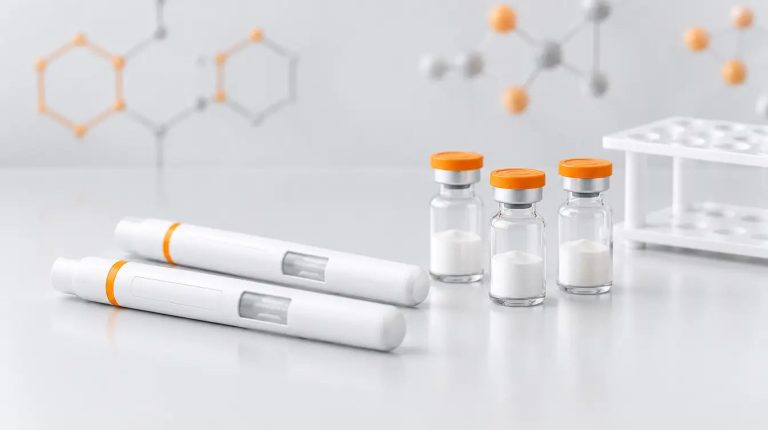
| Formats we list | Lyophilised vial and pre-filled pen |
At about 390 g/mol, Epitalon is tiny next to most research peptides. For comparison, BPC-157 has a molecular weight of roughly 1,419 g/mol, more than three and a half times larger.
Why a tetrapeptide is useful in the lab
Short peptides like Epitalon have some practical advantages for analytical and cell-based work. They are straightforward to synthesise, their identity is simple to confirm by mass spectrometry, and purity can be measured cleanly by HPLC. That makes Epitalon a convenient model compound for laboratories setting up peptide handling, storage or analytical methods.
Published research areas
Most published work on Epitalon is preclinical, meaning it was carried out in cell cultures or animal models. The summaries below describe what studies investigated. They are research context only and are not claims about what the compound does outside a laboratory.
Telomerase and telomere biology in cell cultures
Telomeres are the protective repeat sequences at the ends of chromosomes, and telomerase is the enzyme that can extend them. Telomere biology is a major area of cell research, and Epitalon is best known in the literature for studies in this field.
A 2003 paper in the Bulletin of Experimental Biology and Medicine (Khavinson, Bondarev and Butyugov) reported that adding Epitalon to telomerase-negative human fetal fibroblast cultures was associated with expression of the catalytic subunit of telomerase, telomerase activity and telomere elongation in those cells.
A more recent study published in Biogerontology in 2025 (Al-Dulaimi and colleagues) revisited the question with quantitative methods across several human cell lines, including normal epithelial and fibroblast cells and two breast cancer cell lines. The authors reported telomere length changes in all the lines tested, linked to hTERT and telomerase upregulation in the normal cells and to a mechanism called alternative lengthening of telomeres (ALT) in the cancer lines. A correction to this paper was published later in 2025, and anyone reviewing the study should read the two together.
It is worth being clear about the limits here. These are measurements in cultured cells, and telomere length is a cellular endpoint. Results in a cell line do not show what would happen in a whole organism.
Pineal and melatonin-related signalling in animal models
Because Epitalon was modelled on a pineal extract, a second line of research has looked at pineal gland function in animal models. A 2001 study in Neuro Endocrinology Letters (Khavinson, Goncharova and Lapin) measured melatonin and cortisol secretion patterns in female rhesus monkeys of different ages, comparing animals that were given Epitalon with their baseline measurements. Other papers from the same research group have examined related hormonal and gene-expression questions.
Much of the early Epitalon literature comes from a single research institute, which is something reviewers often note. The 2025 cell-line study is useful partly because it comes from an independent group.
Epitalon formats at Biolabs
We list Epitalon in two formats. Strengths and stock change from time to time, so check the live product pages for what is available on the day you order.
Lyophilised vial
The Epitalon vial is supplied as a freeze-dried (lyophilised) powder, listed in 10 mg and 50 mg strengths. Lyophilised peptides are the most stable format for storage and transport, which is why they suit labs that want to keep stock on hand. Our guide to lyophilised peptides explains why freeze-dried powder holds up so well.
According to the live product page:
- Store unopened vials at −20 °C for long-term storage, or 2–8 °C short-term, protected from light and moisture.
- Vials are stable at ambient temperature during normal courier transit.
- Let the vial reach room temperature before opening, to limit condensation.
- For reconstitution, labs typically use sterile water or bacteriostatic water (0.9% benzyl alcohol), added slowly down the vial wall and swirled gently rather than shaken.
- Store reconstituted solution at 2–8 °C and follow your own validated stability protocol.
If you need a diluent, Genetek bacteriostatic water and other supplies are in our reconstitution supplies and hardware collection. Our bacteriostatic water guide covers the difference between the common diluents.
Pre-filled pen
The Epitalon peptide pen is supplied as a ready-made solution, listed in 10 mg and 50 mg strengths. Pens are made to order and need more care in transit than vials:
- Keep refrigerated at 2–8 °C, protected from light, and do not freeze.
- Pens are dispatched by overnight cold-chain courier.
- Where reliable overnight delivery isn’t available, we recommend the lyophilised vial instead.
- Batch details are on the pen label.
Not sure which suits your lab? Our pens vs vials guide compares shelf life, handling and delivery for both formats. You can also browse every compound in the peptide vials and pre-filled peptide pens collections.
Checking quality: COAs and batch testing
For a compound this small, identity and purity testing is simple and reliable, so there is no reason to accept a product without paperwork. According to the product page, each Biolabs batch is tested by an independent laboratory for identity and purity using HPLC and mass spectrometry, and the batch number on your product should match its certificate.
Certificates are published on our COA page. When you review one for Epitalon, check three things:
- Identity: the mass spectrometry result should be consistent with a molecular weight of about 390 g/mol.
- Purity: the HPLC result shows the share of the sample that is the target peptide.
- Batch match: the batch or lot number should match the one on your vial or pen.
Our guide to reading a peptide COA walks through a certificate step by step.
Buying Epitalon in South Africa: what to look for
Whoever you buy from, a few checks make a big difference:
- Clear specifications: sequence, molecular formula, molecular weight and CAS number should be listed and should match public records.
- Published certificates: independent HPLC and mass spec results, with batch numbers you can match.
- Proper storage advice: a supplier should tell you how to store both the powder and any solution.
- Sensible delivery: vials travel well by standard tracked courier, while solutions need a cold chain.
- Research-only positioning: a reputable supplier sells research peptides for laboratory use and makes no health claims.
Biolabs ships nationwide from local stock with tracked courier delivery, and pens go by overnight cold-chain courier.
Epitalon FAQ
Is Epitalon the same as Epithalon?
Yes. Epitalon and Epithalon are two spellings of the same tetrapeptide, Ala-Glu-Asp-Gly. It is also sometimes written by its one-letter code, AEDG.
Is Epitalon the same as epithalamin?
No. Epithalamin is a complex peptide extract of the pineal gland. Epitalon is a single synthetic sequence that was designed as a defined analogue of it.
How should Epitalon be stored?
Per our product pages, store lyophilised powder at −20 °C long term or 2–8 °C short term, away from light and moisture. Keep reconstituted solution and pre-filled pens at 2–8 °C, and don’t freeze pens.
Which format is best for my lab?
Vials offer the longest shelf life and travel well at ambient temperature. Pens are supplied ready-made but need refrigeration and overnight cold-chain delivery.
Is Epitalon for human use?
Sources
- PubChem. Epitalon, CID 219042. pubchem.ncbi.nlm.nih.gov/compound/219042
- Khavinson VKh, Bondarev IE, Butyugov AA. Epithalon peptide induces telomerase activity and telomere elongation in human somatic cells. Bull Exp Biol Med. 2003;135(6):590-2. PMID 12937682
- Al-Dulaimi S, Thomas R, Matta S, Roberts T. Epitalon increases telomere length in human cell lines through telomerase upregulation or ALT activity. Biogerontology. 2025;26(5):178. PMID 40908429; correction: PMID 41240216
- Khavinson V, Goncharova N, Lapin B. Synthetic tetrapeptide epitalon restores disturbed neuroendocrine regulation in senescent monkeys. Neuro Endocrinol Lett. 2001;22(4):251-4. PMID 11524632
They are not medicines, are No usage guidance is provided. The purchaser is responsible for safe handling and for complying with applicable South African regulations.