5-Amino-1MQ in South Africa: The NNMT Inhibitor Explained
5-Amino-1MQ is one of the most searched-for names in research catalogues right now, and it is also one of the most misunderstood. It is not a peptide at all. It is a small organic molecule used in laboratory enzyme work, and it is best known as an inhibitor of an enzyme called nicotinamide N-methyltransferase (NNMT). This guide to 5-Amino-1MQ in South Africa explains what the compound is, what published laboratory studies have looked at, and the storage and handling details of the vial and pre-filled pen formats we list.
What is 5-Amino-1MQ?
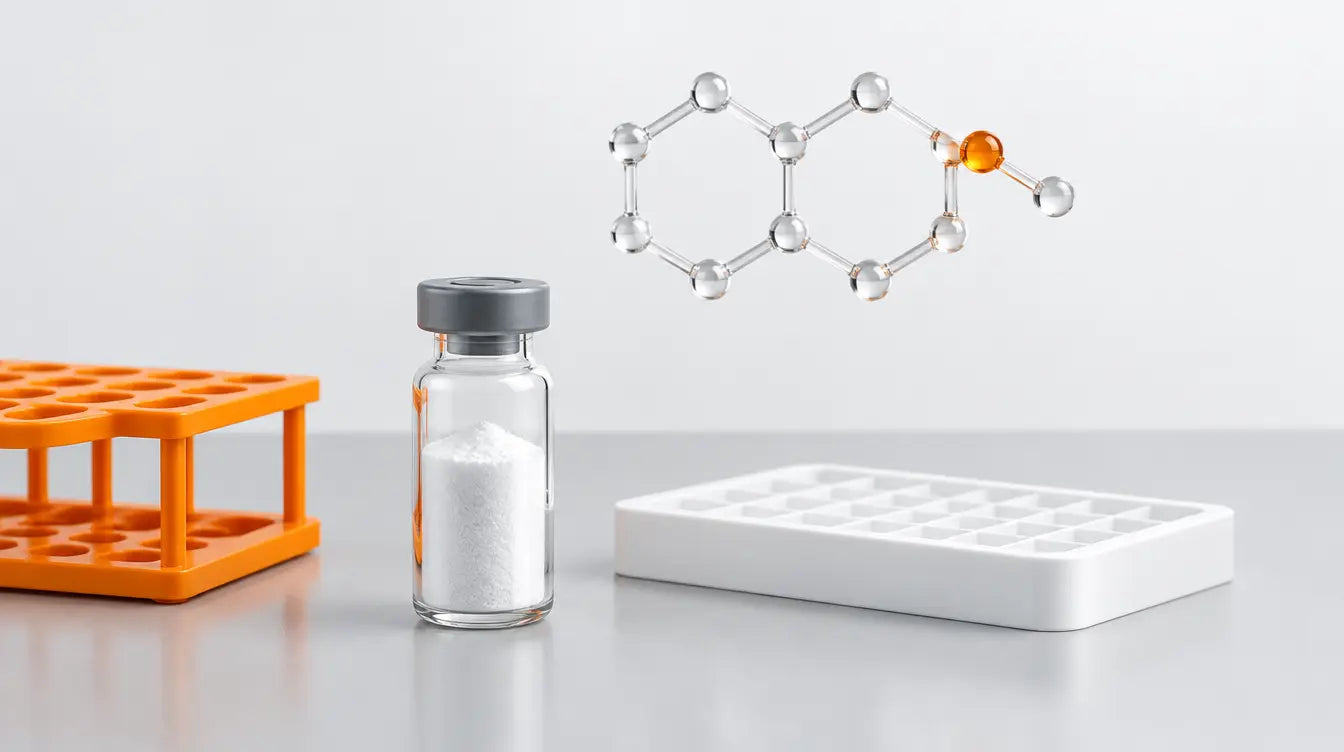
5-Amino-1MQ is short for 5-amino-1-methylquinolinium. Chemically, it is a quinolinium: a flat, two-ring aromatic structure (a quinoline) with a methyl group on the ring nitrogen, which gives the molecule a permanent positive charge, and an amino group on the second ring. It is usually supplied as an iodide salt.
That matters for anyone coming from peptide work. Peptides are chains of amino acids, assembled and analysed in one way. 5-Amino-1MQ is a compact synthetic molecule with no amino acid sequence, so the usual peptide vocabulary (sequence, residues, N-terminus) simply does not apply to it. We say so plainly on the product pages and repeat it here, because labs searching for “5-Amino-1MQ peptide” deserve an accurate description of what they are buying.
The identification details on our live 5-Amino-1MQ vial page are:
| Property | Value |
|---|---|
| Compound | 5-Amino-1-methylquinolinium (5-Amino-1MQ) |
| Type | Small-molecule quinolinium, not a peptide |
| Molecular formula | C10H11IN2 (iodide salt) |
| Molecular weight | 286.1 g/mol (iodide salt) |
| CAS number | 42464-96-0 |
| Formats we list | Lyophilised/solid powder vial and pre-filled pen, in 10 mg and 50 mg |
The public PubChem record for the cation on its own (CID 950107) gives the formula C10H11N2+ and a molecular weight of 159.21, which is consistent once the iodide counter-ion is added to reach the salt figure above.
What is NNMT, and why do labs study it?
NNMT is a cytosolic enzyme that transfers a methyl group from S-adenosylmethionine (SAM) onto nicotinamide, producing 1-methylnicotinamide (1-MNA). Because both SAM and nicotinamide feed into central cellular pathways, including those that involve NAD+, NNMT has attracted interest as a node linking methylation and cellular energy metabolism.
Laboratories use NNMT inhibitors as tool compounds. If you block the enzyme in a cell or an assay, you can measure what happens to 1-MNA, SAM and NAD+ levels and to downstream readouts. A quinolinium such as 5-Amino-1MQ is useful in that context because it is small, defined and easy to characterise.
Published research areas
The studies below were carried out in enzyme assays, cultured cells and animal models. They are described here as research context only. They are not claims about what the compound does outside a laboratory.
Structure-activity work on quinolinium inhibitors
A 2017 paper in the Journal of Medicinal Chemistry (Neelakantan and colleagues) screened N-methylated quinolinium, isoquinolinium, pyridinium and benzimidazolium/benzothiazolium analogues against NNMT. The authors reported that quinoliniums were a promising scaffold, with inhibition in the low micromolar range (IC50 of roughly 1 µM), and they paired the assay data with computer docking of the compounds into the enzyme’s nicotinamide-binding site to explain the structure-activity relationships.
Permeability, selectivity and cultured adipocytes
A follow-up study in Biochemical Pharmacology (Neelakantan and colleagues, 2018) characterised a series of methylquinolinium inhibitors further. According to the abstract, the work covered membrane permeability using artificial-membrane and Caco-2 cell assays, selectivity against related SAM-dependent methyltransferases and NAD+ salvage pathway enzymes, and measurements in cultured adipocytes of intracellular 1-MNA, NAD+ and SAM. The same paper also included experiments in mice fed a high-fat diet. We are summarising the study design here rather than its outcomes, and anyone interested should read the full paper and judge its methods and conclusions for themselves.
Other NNMT inhibitor literature
NNMT inhibitors of several chemical classes have since appeared in the literature, including work in other cell types and in animal models of diet-induced metabolic change. Because the field is still developing, results from different compounds, conditions and models should not be treated as interchangeable, and a finding for one inhibitor does not automatically transfer to another.
As always with preclinical research, enzyme and cell-culture data describe a defined experimental system. They do not show what would happen in a whole organism, and nothing here should be read as guidance for any use of the compound.
5-Amino-1MQ formats at Biolabs
We list 5-Amino-1MQ in two formats, each in 10 mg and 50 mg strengths. Stock and strengths change, so check the live product pages on the day you order.
Lyophilised vial
The 5-Amino-1MQ vial is supplied as a lyophilised (freeze-dried) powder in a sealed glass vial. As with peptides, freeze-dried powder is the most stable format for storage and transport. Our guide to lyophilised peptides explains why, and most of its handling principles apply to any freeze-dried research powder. According to the live product page:
- Store unopened vials at −20 °C for long-term storage, or 2–8 °C for short-term storage, protected from light and moisture.
- Vials are stable at ambient temperature during normal courier transit.
- Allow the vial to reach room temperature before opening, to limit moisture uptake.
Choosing a solvent, concentration and stability protocol is the responsibility of the research team and should follow their own validated method. If your lab prepares solutions from powder, our reconstitution supplies and hardware collection lists the sterile water, bacteriostatic solutions and consumables we stock, and the bacteriostatic water guide covers how those solutions differ. You can browse every powder format in the vials collection.
Pre-filled pen
The 5-Amino-1MQ pre-filled pen is a ready-made solution supplied in a pen and made to order. Per the live page, keep it refrigerated at 2–8 °C, protected from light, and do not freeze it. Refer to the pen label for batch details. If you are weighing the two formats against each other, our pens vs vials guide sets out the trade-offs, and the pre-filled pens collection shows the full range.
Delivery in South Africa
Delivery depends on the format. Pens are fridge-line items, so they ship cold-chain with RAM Fridgeline, which keeps them refrigerated in transit. Vials and other non-fridge items ship with Courier Guy, and different service levels are available at checkout. Our guide to delivery, cold chain and storage on arrival walks through what to do when a parcel lands. If cold-chain delivery to your address is a concern, the lyophilised vial is the simpler format to transport.
Quality and the COA
The product pages for 5-Amino-1MQ direct buyers to the batch COA for purity. Our COA page publishes independent HPLC and mass spec results with batch numbers you can match, but it does not currently list a dedicated 5-Amino-1MQ card, so ask for the certificate for your batch before you order and match the batch number on your vial or pen label against it. If you are new to reading these documents, our guide to reading a COA, HPLC purity and mass spec explains what each section means. For a wider overview of choosing a supplier, see the research peptides buyer’s guide.
Frequently asked questions
Is 5-Amino-1MQ a peptide?
No. It is a small-molecule quinolinium compound. It is often grouped with research peptides in catalogues, but it has no amino acid sequence.
What is 5-Amino-1MQ used for in research?
In published laboratory work it is used as an inhibitor of the enzyme NNMT, in enzyme assays, cultured cells and animal models. Our product pages give identification and handling information only.
How should 5-Amino-1MQ be stored?
Per the live product pages, store the lyophilised vial at −20 °C long term (2–8 °C short term), protected from light and moisture. The pre-filled pen should be kept at 2–8 °C, protected from light, and not frozen.
How is 5-Amino-1MQ delivered in South Africa?
Pens ship cold-chain via RAM Fridgeline. Vials ship via Courier Guy, with different service levels at checkout.
Is there a certificate of analysis?
The product pages refer buyers to the batch COA for purity. Our COA page publishes batch results, but it has no dedicated 5-Amino-1MQ card at the moment, so request the certificate for your batch before ordering.
Is 5-Amino-1MQ for human use?
Sources
- PubChem. 1-Methylquinolin-1-ium-5-amine (5-amino-1-methylquinolinium cation), CID 950107. pubchem.ncbi.nlm.nih.gov/compound/950107
- Neelakantan H, Wang HY, Vance V, et al. Structure-activity relationship for small molecule inhibitors of nicotinamide N-methyltransferase. J Med Chem. 2017;60(12):5015-5028. PMID 28548833
- Neelakantan H, Vance V, Wetzel MD, et al. Selective and membrane-permeable small molecule inhibitors of nicotinamide N-methyltransferase reverse high fat diet-induced obesity in mice. Biochem Pharmacol. 2018;147:141-152. PMID 29155147
They are not medicines, are No usage guidance is provided. The purchaser is responsible for safe handling and for complying with applicable South African regulations.