Copper Peptide Skincare in South Africa: GHK-Cu, AHK-Cu and SNAP-8 Explained
Copper peptides have become one of the most talked-about ingredient groups in South African skincare and hair care. Search for “copper peptide skincare South Africa” and you will find bold promises everywhere. This guide takes a calmer route. It explains what GHK-Cu, AHK-Cu and SNAP-8 actually are, what each one is being studied for in plain language, how to read a copper peptide label, and how the Biolabs cosmetics range is put together.
What are copper peptides?
A peptide is a short chain of amino acids. A copper peptide is a small peptide that holds a copper ion. The two copper peptides you will see most often on cosmetic labels are both tripeptides, meaning they are only three amino acids long:
- GHK-Cu (glycyl-histidyl-lysine copper). On an ingredient list (INCI) it appears as Copper Tripeptide-1.
- AHK-Cu (alanyl-histidyl-lysine copper). On an INCI list it appears as Copper Tripeptide-3.
The copper is also why many copper peptide products have a blue tint. A light-blue serum or cream is normal for this ingredient group and comes from the copper itself, not from added colourant.
Where does SNAP-8 fit in?
SNAP-8 is often sold next to copper peptides, but it is not one. It is an eight-amino-acid peptide listed on labels as Acetyl Octapeptide-3. It contains no copper and belongs to a different family of cosmetic peptides. It is included in several Biolabs formulas alongside GHK-Cu.
What are these ingredients being studied for?
Here is the honest picture in everyday language. Most of the research on these ingredients was done in cell cultures, isolated tissue or small cosmetic studies. It shows what scientists are looking at. It does not promise any particular result from a skincare product.
GHK-Cu: being studied for skin structure
GHK-Cu is mainly being studied for its role in the skin’s support structure. In laboratory work it has been looked at for how it relates to collagen, elastin and glycosaminoglycans (the materials that help give skin its framework), and to the activity of dermal fibroblasts, the cells that produce them. A widely cited 2018 review by Pickart and Margolina in the International Journal of Molecular Sciences summarises this work and the gene-expression data behind it (PubMed 29986520).
It is also worth knowing the limits. A 2026 systematic review in Archives of Internal Medicine Research describes the preclinical body of GHK-Cu evidence as large, but notes that human studies remain small and limited, and calls for better-designed trials (PubMed 42787770). That is why we describe GHK-Cu as being studied, not proven.
AHK-Cu: being studied for hair follicles
AHK-Cu is mostly being studied in connection with hair. In a 2007 laboratory study from Seoul National University, published in Archives of Pharmacal Research, researchers applied AHK-Cu to human hair follicles kept alive outside the body and to cultured dermal papilla cells, the cells at the base of the follicle (PubMed 17703734). This was lab-bench research on isolated follicles and cells, not a study of people using a shampoo, so it tells us what AHK-Cu is being studied for rather than what a hair product will do.
SNAP-8: being studied for expression lines
SNAP-8 is being studied as a cosmetic peptide for the look of expression lines, the fine lines that form where the face moves most. It appears in cosmetic research mainly as one ingredient within multi-ingredient formulas, so its effect alone is hard to separate out.
Copper peptide formats: what is in the Biolabs range
Biolabs groups its copper peptide products in the Cosmetics collection. They fall into a few clear formats.
Face serums
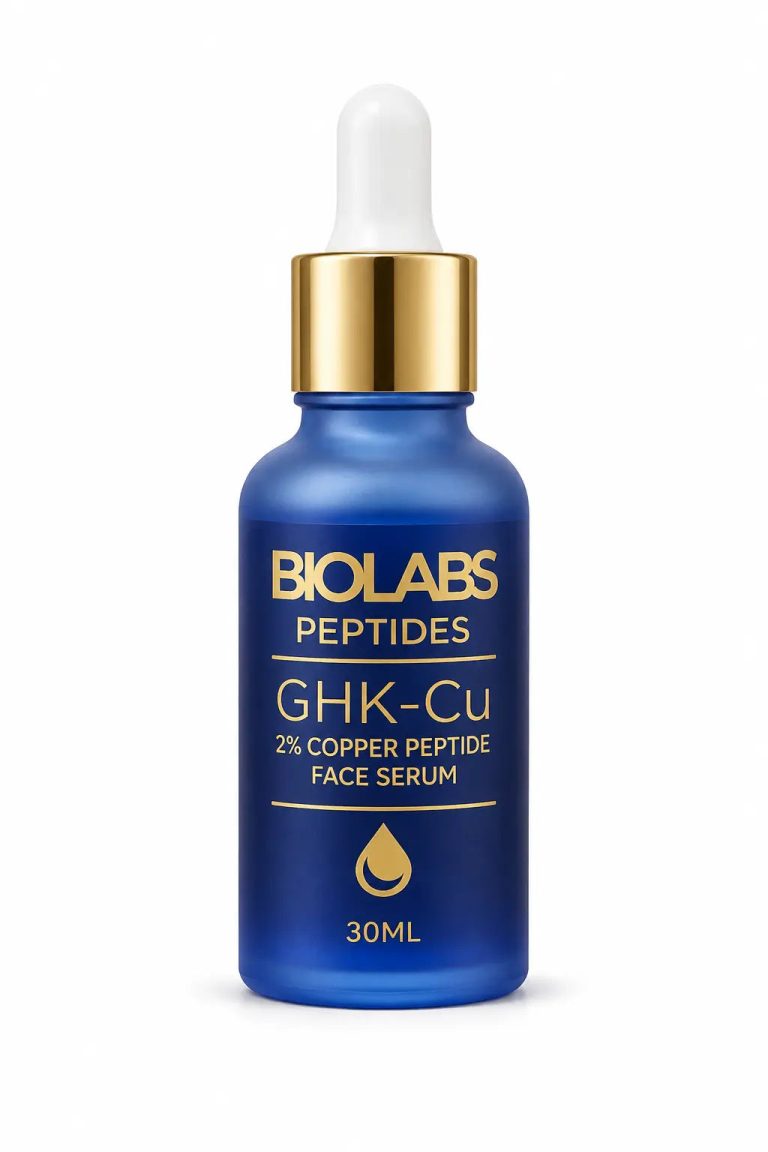
Serums are light, water-based formulas. The Biolabs 2% GHK-Cu Copper Peptide Face Serum carries our highest GHK-Cu percentage, while the 1% GHK-Cu + SNAP-8 Peptide Face Serum combines five peptides, including GHK-Cu and SNAP-8, with hyaluronic acid. Both are clear-blue serums with a non-greasy finish.
Creams and masks
Creams add oils and butters for a richer texture. The SNAP-8 + GHK-Cu Copper Peptide Renewal Cream pairs both peptides with niacinamide, panthenol, ceramides and squalane, and is light blue from the GHK-Cu. The newer GHK-Cu Copper Peptide Renewal Mask comes as a box of five 30 ml sheet masks.
Hair care
The GHK-Cu + AHK-Cu hair care line, which Biolabs launched as the first AHK-Cu hair care line in South Africa, includes the Fortifying & Smoothing Shampoo and the matching Intensive Smoothing Conditioner. Both carry Copper Tripeptide-1 and Copper Tripeptide-3. A leave-on AHK-Cu scalp serum and scalp spray sit in the same collection.
Cosmetic-grade raw powders
For experienced cosmetic formulators, Biolabs also supplies GHK-Cu, AHK-Cu and SNAP-8 as cosmetic-grade raw-material powders. These are ingredients for formulation work, not finished products, and they are not for direct use on skin in undiluted form.
How to read a copper peptide label
A few quick checks help you compare copper peptide products in South Africa, whoever makes them:
- Look for the INCI name. “Copper Tripeptide-1” means GHK-Cu, and “Copper Tripeptide-3” means AHK-Cu. “Acetyl Octapeptide-3” is SNAP-8. If a product says “copper peptide” but none of these names appear on the ingredient list, ask why.
- Check how the percentage is measured. Biolabs states GHK-Cu percentages as peptide powder by weight. Brands use different methods, so two “1%” claims are not always comparable.
- Note the position on the list. Ingredients are listed roughly from most to least by quantity. Peptides are used at low levels, so they often appear towards the end, which is normal.
- Expect a blue tint. A pale blue colour is typical when GHK-Cu or AHK-Cu is present in a meaningful amount.
- Ask for documentation. For raw powders, ask for a certificate of analysis. Biolabs publishes batch documents on its COA page.
Storage tips for copper peptide products
Peptides are sensitive to heat and light, and South African summers can be hot. Keep finished products in a cool, dry place out of direct sunlight, close the lid or pump after each use, and avoid leaving them in a hot car. Raw peptide powders should be kept sealed at 2–8 °C, or at −20 °C for longer storage, and brought to room temperature before opening so moisture does not condense inside.
If you would like more background, our earlier articles cover GHK-Cu and AHK-Cu for hair in more depth.
Frequently asked questions
Why is my copper peptide serum blue?
The blue colour comes from the copper bound to the peptide. A light-blue serum or cream is normal for GHK-Cu and AHK-Cu products.
What is the difference between GHK-Cu and AHK-Cu?
They are both copper tripeptides and differ by one amino acid. GHK-Cu is mainly being studied for skin structure, while AHK-Cu is mainly being studied in connection with hair follicles.
Is SNAP-8 a copper peptide?
No. SNAP-8 (Acetyl Octapeptide-3) contains no copper. It is a separate cosmetic peptide that is often used in the same formulas as GHK-Cu.
Do Biolabs cosmetics ship within South Africa?
Yes. The Biolabs cosmetics range is available to order on biolabsresearch.co.za with delivery across South Africa.
Will copper peptides give me a specific result?
No result is promised. The research described above shows what these ingredients are being studied for. Individual experience with any cosmetic product varies.
Important notice
Research use and cosmetic notice: Biolabs research compounds, including peptide vials, pens and nasal sprays, and our cosmetic-grade raw-material powders are sold strictly for laboratory research and formulation use only. They are The finished cosmetics described in this article are for external cosmetic use only, as directed on the pack. They are not medicines and are This article is general information about published research areas and does not promise any outcome.
Related: browse all GHK-Cu and AHK-Cu formats in our copper peptides collection.